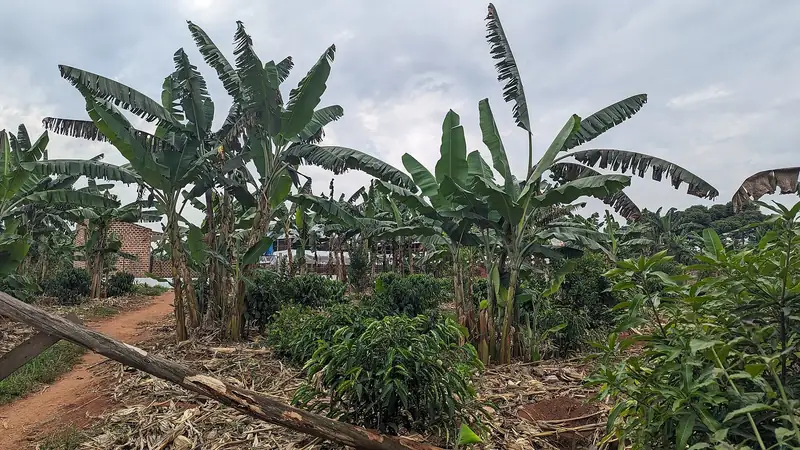
Drive through the hills of Mount Elgon, the Rwenzori foothills or central Uganda and you will see a pattern that surprises many visitors: coffee bushes and banana stands growing under scattered trees, with beans, maize or vegetables planted nearby. Farmers did not invent this for carbon. They did it for shade, fruit, firewood, soil fertility and a more stable harvest. Agroforestry is simply the deliberate mixing of trees with crops or livestock, and it is one of the most practical ways to add carbon storage to land that is already farmed.
Why trees on farms store carbon
A growing tree takes carbon dioxide from the air and builds it into wood, roots and leaves. Some of that carbon also enters the soil through fallen leaves and dying roots. On a farm, the trees stand alongside crops instead of replacing them, so the household keeps its harvest while the amount of carbon held on the land rises over the years. The gain depends heavily on the species chosen, how densely they are planted, how long they are left standing and how they are pruned. A shade tree cut for charcoal after five years stores far less than one left to mature.
Common agroforestry patterns in Uganda
Several systems are widespread. Coffee, both robusta in the centre and south and arabica on the mountain slopes, is often grown under shade trees such as Albizia or Markhamia, and sometimes with fruit trees like avocado or jackfruit. Banana-coffee intercropping is common in the central and western regions. Boundary planting, where trees line field edges or paths, takes up little cropland. Woodlots on the less fertile corners of a farm supply poles and firewood, which can reduce pressure on nearby natural forest. Each pattern carries different amounts of carbon, and a project must treat them separately.
What has to be measured
A credible agroforestry project does not guess. It first maps the participating plots, usually with GPS and satellite imagery, and records who holds the land rights. Then it measures a sample of trees, typically their trunk diameter and height, and converts these measurements to biomass with equations suited to the species and region. Soil carbon can be sampled too, though it changes slowly and is harder to verify. These measurements are repeated over time, and an independent auditor checks them. The result is the difference between the carbon held with the project and the carbon that would have been held without it, which is why a baseline matters so much.
The difficulties worth being honest about
Agroforestry on smallholder land is more demanding than it looks. Plots are small and numerous, so monitoring costs are high relative to the carbon involved. Many farmers hold land under customary tenure, so agreements must be clear about who owns the trees and any benefits. Trees can die in drought, burn, or be cut when a family faces a cash shortage, and projects need a way to deal with that risk. Benefit sharing must reach the farmers who actually tend the trees, not stop at an intermediary. Finally, farmers need practical help, such as seedlings, training and follow-up visits, because a planted tree that is not looked after produces neither fruit nor carbon.
Benefits beyond carbon
For many families the most visible benefits have nothing to do with carbon. Shade can moderate temperatures for coffee plants, which is helpful as weather becomes less predictable. Leaf litter and nitrogen-fixing species can improve soil. Fruit adds food and a little income, and farm-grown firewood and timber can save hours of collection. These benefits are the reason agroforestry has a long history in Uganda, and a good carbon project builds on them instead of competing with them.
Frequently asked questions
Does agroforestry mean farmers lose cropland?
Not necessarily. Well-designed systems keep crops in production and use trees at moderate density, boundaries or field corners. The design should be agreed with each household.
How long does it take for trees to store meaningful carbon?
Growth varies by species, rainfall and soil, but storage builds over many years. Projects therefore plan for long commitments, often measured in decades.
Is every farm tree counted?
No. Only trees planted or protected under the project, and inside its documented boundaries, can be counted, and existing trees that would have stood anyway do not add to the result.
Do farmers get paid directly for the trees?
It depends on the contract. In most projects a share of the credit income goes to the participating farmers, often through a group or cooperative, and the terms are set out in the project's benefit-sharing arrangement. Ask who receives the money, how often it is paid, and what happens to a farmer's income if trees are lost, before signing anything.
Where can I learn about the wider market?
Our overview of Uganda's carbon markets explains the project types and the questions to ask of any project.