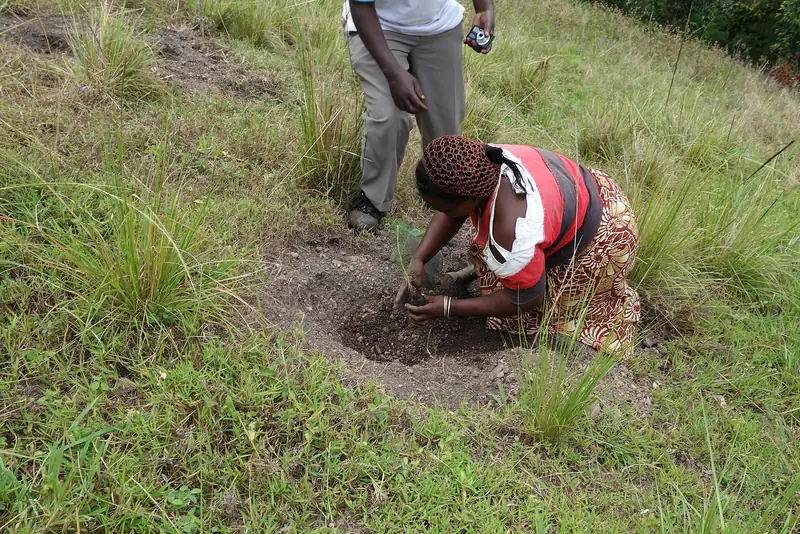
Most carbon projects in Uganda protect a forest that is already standing. Afforestation and reforestation projects work the other way round: they plant trees on land that has no forest, or restore trees on land that was cleared, and they claim the carbon those trees store as they grow. The method is well established, but it asks more of a buyer, because the carbon arrives slowly and depends on the trees surviving.
What Counts as ARR
Carbon standards group these projects under afforestation, reforestation and revegetation, usually shortened to ARR. Afforestation means planting trees on land that has not recently been forest. Reforestation means restoring trees on land that was forest but was cleared. Revegetation covers planting or natural regrowth on degraded land that does not meet a forest definition. Each category has its own eligibility test, and that test is set by the methodology a project uses, not by the project's own description of itself.
How the Carbon Is Counted
An ARR credit is an estimate of the carbon that trees store above and below ground, usually across a crediting period of many years. The project measures tree growth in sample plots, applies allometric equations that turn tree dimensions into biomass, and adds a share for roots, dead wood and soil where the methodology allows. Trees grow slowly in their early years, so most projects issue small volumes at first and larger volumes later. A buyer should expect modest numbers from young plantings, and should be wary of any project that promises large volumes from newly planted seedlings.
Survival Is the Central Risk
A planted tree that dies stores no carbon. Projects therefore have to show survival rates, a replanting plan and a way to cover losses. Most standards require a buffer pool, a share of credits held back against reversal. The size of that deduction comes from the risk assessment in the methodology, and a young plantation exposed to drought, fire or livestock can carry a larger one than a mature forest. The buffer pools and permanence guide explains how these reserves work.
Who Owns the Land and the Trees
Planting ties up land for many years, so the land rights question is sharper than it is for a project that only protects a forest. Ask who holds the title or long lease, whether the planter has written permission to plant and to claim carbon for the full crediting period, and what happens if the owner or a neighbouring household changes the land use. The land tenure guide covers these questions in more detail.
Additionality Is Easier to Show, but Still Needs Proof
Land that was cleared and left bare has a clear baseline: without planting, the carbon would not have increased. That makes the additionality argument simpler than it is for protecting a standing forest. It does not remove the need for evidence. Buyers should check that the land is not already being restored under a government or donor programme that would have happened anyway, and that the planting is not a repackaging of trees a farmer was already obliged to plant. The additionality and baselines article sets out the tests.
Leakage and Land Use Shift
Planting on one plot can push farming or grazing onto another. A project should show how the planted area was used before, and how it manages any activity that moves elsewhere. Our guide to leakage in forest projects explains how to test for this.
Species, Native Trees and Community Benefit
Species choice affects both carbon and biodiversity. Fast-growing exotic species can store carbon quickly but may offer less habitat than a mix of native trees. Some projects combine timber, fruit and shade trees with the crops farmers already grow, which can give households income while the carbon builds up. Ask which species are planted, where the seedlings come from and whether the plan includes native trees. Benefit sharing should be written down as well, as our community benefit sharing guide explains.
A Buyer's Checklist
Before buying ARR credits from a Ugandan project, ask the seller for written answers to four questions. (1) Which methodology and version does the project use, and does the land meet its definition of afforestation, reforestation or revegetation? (2) What are the survival rates in the latest monitoring report, and how is the buffer set? (3) Who holds the land and the carbon rights for the full crediting period? (4) Which species are planted, and how are leakage and community benefits handled?
Frequently Asked Questions
Are tree planting credits the same as ARR credits?
Often they are. Tree planting is the activity, and ARR is the family of standard methodologies that covers it. The tree planting article explains why a planted tree is not yet a credit.
Do ARR credits take a long time to appear?
Yes. Trees grow slowly and verification happens at set intervals, so volumes usually build over several years rather than arriving at once.
Is an ARR credit safer than a forest protection credit?
Not automatically. Planted forests face survival risk, while protected forests face the risk that the threat was lower than the baseline assumed. A credit is only as sound as its methodology, monitoring and buffer.
Where should I read next?
Read REDD+ in East Africa to compare planting with forest protection, and how to buy carbon credits in Uganda for the purchase steps.